










pipeBOT™
Closed-loop control for liquid pipelines, with up to 85% fewer manual commands.

draBOT™ autonomously controls your DRA injection skids, managing injection rates, skid switching and timing across pumps, flow paths and batches.
Results from client deployments








Under-injection makes pumps work harder to hold delivery rates. Over-injection wastes DRA and can put product quality at risk at batch interfaces.
01
Without enough DRA, flow is limited and pumps need more power to hold delivery rates.
02
Excess DRA goes into the pipeline when it isn't needed, and that cost adds up.
03
DRA at batch interfaces can force spec products like jet fuel to be sold as downgraded product.
Manages injection rates, skid switching and timing across pumps, flow paths and batches.
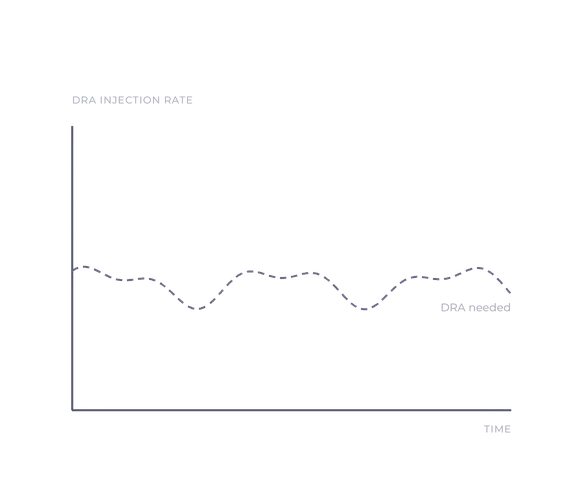
Calculates injection rates from flow and pressure profiles, accounting for shear and product properties.
Shuts skids off ahead of batch interfaces, so no DRA buffer zones form.
pipeBOT™ tracks DRA along the line; draBOT™ adds control of the injection equipment itself.
Every command passes through your SCADA/DCS, and operators can override at any time. ISO 27001 · SOC 2 Type II.
Read the safety FAQUnder-injection avoided: $432k
Over-injection + contamination: $85k
CruxOCM modeled the cost of manual DRA errors on a 65k bpd, 300+ mile pipeline with 2 pump stations.
3–8%
lower DRA costs
$432k/yr
estimated energy saved by avoiding under-injection
$85k/yr
estimated from over-injection and contamination
draBOT™ is CruxOCM's automation software for drag reducing agent (DRA) injection. It autonomously controls DRA injection skids, managing injection rates, skid switching, and timing, so DRA dosing stays precise and under- and over-injection are reduced. Deployments deliver a 3–8% reduction in DRA costs.
Tell us about your pipeline. CruxOCM will estimate the DRA and energy savings draBOT™ could deliver.
Closed-loop control for liquid pipelines, with up to 85% fewer manual commands.
Automates gathering systems, with 90% fewer tank excursion penalties.
Calculates throughput targets for a 2–7% increase on prorated pipelines.
Calculates the minimum safe hydraulic profile for 1–3% lower power costs.
Meets contracted volume at the lowest power cost, with up to 10% savings.