












maxOPT™
Calculates throughput targets for a 2–7% increase on prorated pipelines.

pipeBOT™ runs closed-loop control on your existing SCADA, adjusting in seconds instead of minutes, so your controllers supervise instead of execute.
Results from client deployments








SCADA executes commands, but it doesn't close the loop. Your controllers do, one command at a time, on every shift.
01
Alarms set the pace, and each late response can trigger the next one.
02
Experience levels vary, so routine operations vary with them.
03
A client's controllers made 280 manual setpoint changes a day before pipeBOT™.
Controllers supervise instead of execute, with up to 50% fewer alarms and full authority to override.
Reads, acts and adjusts every cycle, combining setpoint control and pump actions in one system.
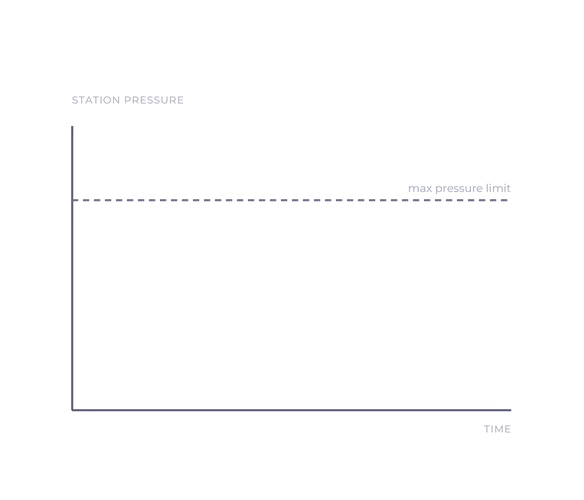
Many small adjustments instead of a few large ones keep pressure in a tight, stable band.
Automates flow rate changes, pump starts and swaps, and batch handling.
Every command passes through your SCADA/DCS, and operators can override at any time. ISO 27001 · SOC 2 Type II.
Read the safety FAQManual control: 100
pipeBOT™: <20
A major midstream operator moved its pipeline from manual control to pipeBOT™.
>80%
fewer manual commands
50%
fewer alarms
Up to $1.2M/yr
OPEX savings in one client deployment
From the control room
I turn it on always as I start my shift, and it’s working.
pipeBOT™ is CruxOCM’s closed-loop control software for liquid pipelines. It reads real-time data, executes control actions, tracks how the pipeline responds, and adjusts every 5–15 seconds. It does what advanced process control (APC) does, continuous setpoint adjustment, and adds what APC isn’t built for: discrete control such as pump starts and stops and unit swaps. pipeBOT™ orchestrates both in a single system, so operators no longer have to make each command by hand.
Tell us about your pipeline. CruxOCM will estimate what pipeBOT™ could change in commands, alarms and pressure stability.
Calculates throughput targets for a 2–7% increase on prorated pipelines.
Calculates the minimum safe hydraulic profile for 1–3% lower power costs.
Meets contracted volume at the lowest power cost, with up to 10% savings.
Adds autonomous DRA skid control for 3–8% lower DRA costs.
Automates gathering systems, with 90% fewer tank excursion penalties.