IT/OT convergence is the integration of information technology (IT), the systems that run the business, with operational technology (OT), the systems that run physical equipment. In heavy industry, it means operational data from the control room reaches the people and systems that plan, schedule, maintain, and finance the operation, so decisions are based on what is happening in the field.
The two sides have different jobs:
- Operational technology (OT) runs the physical operation. For an oil and gas company, it includes DCS and SCADA systems, PLCs, field sensors, pumps, valves, and the control systems that monitor and manage production, transportation, and refining. OT's priorities are safety and reliability: keeping the process running, 24 hours a day.
- Information technology (IT) runs the business. It includes email, accounting and ERP systems, customer databases, and the networks and data platforms that manage business information. IT's priority is protecting data and keeping business processes running.
For decades, these two environments were kept separate for good reason. Today, the Industrial Internet of Things (IIoT), a network of industrial sensors and connected devices, makes it possible to collect large amounts of data from OT assets securely and send it to IT systems for analysis.
This article explains how IT/OT convergence works in practice, with a focus on oil and gas: the types of convergence, its benefits and challenges, examples from energy and midstream operations, convergence strategies, security best practices, and the compliance rules that apply to pipelines in North America.
What Is IT/OT Convergence?
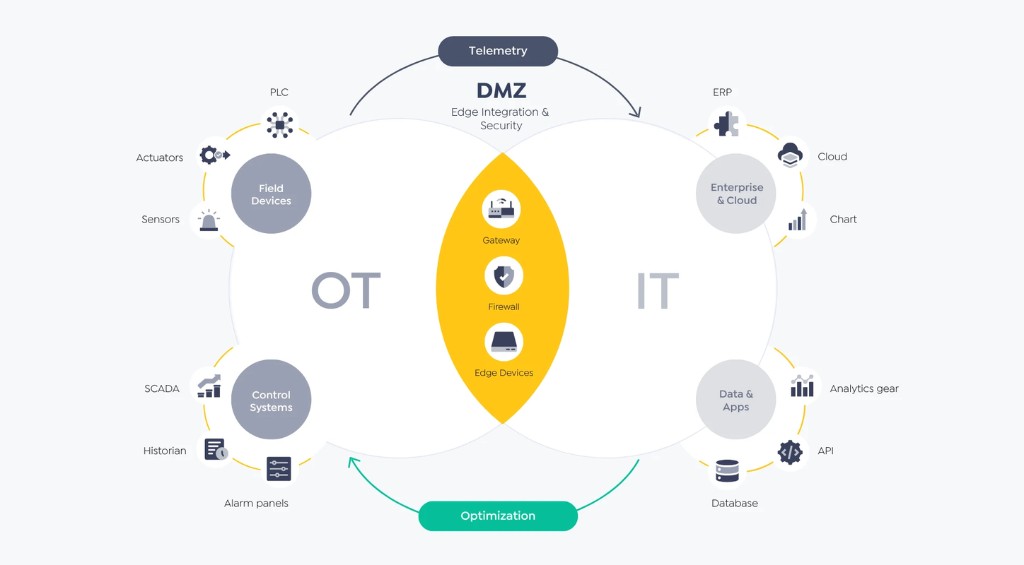
IT/OT convergence is the point where operational data stops being isolated in the control room and starts creating value for the entire business. Take midstream pipeline operations as an example. Technically, convergence connects the systems that control physical assets, such as pumps and valves, to the data-processing systems that run the business. In practice, it means taking the large volumes of data from pipeline sensors (OT) and feeding them into an analytics platform (IT). That platform can identify patterns that indicate a potential leak, show the most energy-efficient way to run pumps, or help schedule maintenance before a critical part fails. It turns operational data into business intelligence, as part of the wider digital transformation of industry and Industry 4.0.
The architecture has also changed. The older approach used many separate network layers to keep IT and OT isolated. The current approach uses edge computing to process time-sensitive data at the source, then sends selected data and results to cloud platforms for deeper analysis. This gives operators immediate operational information and gives the business long-term insight.
One rule holds in a well-designed converged architecture: data flows out of OT to IT, and IT systems do not reach into OT to control equipment. Control actions stay inside the OT environment.
Types of IT/OT Convergence
IT/OT convergence happens in stages. It can be broken down into three levels of integration:
- Process and organizational convergence: The starting point is getting people to work together. IT departments and OT engineers stop working in silos and collaborate on projects. They develop a shared plan and learn each other's priorities, which is the first step for any successful integration.
- Network convergence: This connects the technical infrastructure. A secure, controlled connection between IT and OT networks lets data flow between them. It requires careful design with firewalls, demilitarized zones (DMZs), and other security measures, so the business gets the data it needs without exposing critical operations to new risks.
- Data and application convergence: This is where most of the return on investment comes from. It is the deepest level of integration, where data from the SCADA system feeds business analytics, maintenance, or financial planning software. Managers can see how a change in operating efficiency affects profitability and tie field performance directly to business outcomes.
| Feature | Process and organizational convergence | Network convergence | Data and application convergence |
|---|---|---|---|
| Primary goal | Align teams and governance | Enable controlled data flow between networks | Use OT data in IT applications |
| Key technologies | Project management tools, shared KPIs | Firewalls, DMZs, industrial Ethernet, gateways | APIs, data platforms, cloud platforms, analytics software |
| Complexity | Low to medium | Medium to high | High |
| Business impact | Shared priorities and fewer conflicting projects | Basic visibility into operations from the business side | Data-driven decision-making and optimization |
All three types share the same aim: breaking down the silos between IT and OT to improve business performance and data visibility.
Benefits of IT/OT Convergence
The benefits of IT/OT convergence in oil and gas and other industrial sectors come from using operational data across the business. In practical terms:
- Higher operational efficiency: Real-time data from OT systems supports continuous monitoring and optimization of industrial processes. This helps reduce energy consumption, minimize waste, and improve asset utilization, which lowers operating costs.
- Better decisions: When control room managers and operators have access to real-time production data, they make faster, better-informed decisions. IT/OT integration also gives executives a direct view of operations, which aligns operating reality with business strategy.
- Predictive maintenance: Applying analytics and machine learning to equipment sensor data lets companies predict failures before they happen. Moving from reactive or calendar-based maintenance to predictive maintenance reduces downtime, lowers repair costs, and extends asset life.
- Safety and compliance: A unified view of the operation helps teams monitor for safety incidents and meet regulatory requirements. Automated monitoring and reporting simplify compliance and reduce human error.
- Profitability and innovation: More efficient operations, less downtime, and better decisions improve the bottom line. A converged infrastructure is also the foundation for new data-driven services.
Challenges of IT/OT Convergence
The first challenge of IT/OT convergence is cybersecurity. When OT environments that were historically isolated connect to IT networks, they need multi-layered security to protect critical infrastructure. The second is aligning the priorities of IT and OT teams. IT traditionally focuses on keeping data confidential, while OT prioritizes uptime and safety. A shared governance model, with clear rules about which data moves where and who can change what, brings the two together so operations stay both secure and reliable.
The third challenge is legacy equipment. Many industrial facilities rely on decades-old infrastructure and proprietary communication protocols that were never designed to connect to an IT network. A full system replacement is usually too expensive and too disruptive, so the practical path is a hybrid approach: adding modern gateways and software on top of the existing OT infrastructure. Infrastructure-agnostic software that works with the systems already in place can bring data together and automate operations without the cost and disruption of a "rip and replace" project. Operators keep the equipment they rely on, and convergence becomes achievable and cost-effective.
Other challenges include the skills gap between IT and OT teams, complex regulatory requirements, and the added complexity of managing a converged network.
Examples of IT/OT Convergence
IT/OT convergence examples span every industry with significant physical infrastructure. The most common include:
- Predictive maintenance: In manufacturing and industrial settings, sensors on machinery (OT) stream vibration, temperature, and pressure data to analytics platforms (IT). Machine learning models detect anomalies and predict failures, so maintenance is scheduled before the equipment breaks down. This reduces unplanned downtime and repair costs and extends asset life.
- Smart grid management: In the utilities sector, data from grid sensors and smart meters (OT) is combined with IT analytics and grid management systems. Utilities use it to reroute power during faults, balance loads in real time, and give customers detailed usage data.
- Integrated logistics and supply chain: In transportation, GPS trackers on trucks, sensors on containers, and automated warehouse systems (OT) send location and status data to supply chain software (IT). This enables real-time shipment tracking, route optimization, and dynamic inventory management.
- Integrated manufacturing operations: Enterprise resource planning (ERP) systems (IT) are integrated with manufacturing execution systems (MES) on the factory floor (OT). Sales and inventory data directly inform production schedules, which improves resource use and reduces waste.
- Combining siloed legacy systems: In mining, convergence links haul-truck fleet systems with central plant control and planning. Truck telemetry, dispatch, and payload data (OT) are combined with plant management software (IT), so mines can align haul cycles with crusher availability, reroute trucks based on queue lengths, and trigger maintenance from condition trends, without replacing existing systems.
- Remote asset management: Companies monitor and manage physical assets from a central location. This is valuable in industries with distributed infrastructure, such as energy and transportation, for inspections and damage assessments.
The industries that gain most from IT/OT convergence are those with large physical infrastructure and complex operating processes, such as manufacturing, transportation, and utilities. The energy industry, and oil and gas in particular, gains a great deal because its operations are critical and asset-heavy.
Artificial Intelligence (AI) in the energy industry refers to the deployment of advanced algorithms, machine learning, and data analytics to automate and optimize various processes across the energy sector. In other words, AI technologies perform tasks that once relied on human intelligence, but they do so with far greater speed and accuracy when it comes to processing large volumes of data.
AI in the energy industry has undergone a remarkable transformation, evolving from early experimental applications to a pivotal force driving modern industrial operations. The journey began in the 1990s, when the sector first explored the use of machine learning and basic automation to enhance reservoir modeling and streamline maintenance scheduling. These initial efforts laid the groundwork for a more data-driven approach to managing complex energy systems. As computational power, data storage, and sensor technologies advanced, so did the sophistication of AI applications. The integration of big data analytics, the Internet of Things (IoT), and cloud computing throughout the 2000s and 2010s enabled the energy sector to collect and analyze vast amounts of operational data in real time. This technological leap made it possible to move beyond simple automation, empowering companies to implement intelligent systems capable of predictive maintenance, dynamic energy forecasting, and adaptive grid management.
Today, AI technologies have become indispensable in industrial energy settings, enabling smarter operations, enhanced sustainability, and increased profitability. This makes the energy industry not only more efficient and resilient, but also better positioned to meet market demands. AI's ability to process and interpret complex data in real time allows control room operators to make decisions that are both economically and environmentally sound, achieving a level of sustainability and profitability that was previously unattainable.
IT/OT Integration Use Cases in the Energy Industry
In the broader energy sector, IT/OT convergence supports more efficient and resilient power systems. Key use cases include:
- Grid modernization and optimization: Combining data from grid sensors and smart meters with IT analytics gives utilities real-time visibility into the grid. They use it to balance supply and demand, prevent outages, and integrate renewable energy sources.
- Management of distributed energy resources (DERs): As solar and wind generation grows, convergence is needed to manage these decentralized assets. Combining performance data from renewable sites (OT) with energy trading and enterprise systems (IT) supports dispatch decisions and grid balancing.
- Predictive maintenance for generation assets: Wind turbines, solar farms, and power plants carry sensors that monitor critical components. IT systems analyze that data to predict maintenance needs, which reduces downtime and extends asset life.
IT/OT Integration Use Cases in the Oil and Gas Sector
In the oil and gas industry, connecting operational and business technology brings practical advantages at each stage of the value chain:
- Upstream exploration and production: Convergence connects drilling controls and sensor data with analytics to improve drilling plans, monitor remote wellheads in real time, and reduce safety risks through early anomaly detection. In mining operations, the same approach links smart drills, telemetry, and planning software to improve blast precision, coordinate equipment utilization, and enhance crew safety with real-time insights.
- Downstream refining and processing: Converged data improves process monitoring and supports predictive maintenance on pumps and compressors. It also connects operations with planning, so refiners can match the crude slate to unit capabilities and market conditions and adjust the product mix to current margins, demand, and inventory.
- Midstream pipeline and storage operations: Midstream operators rely on SCADA systems to run large pipeline networks. Sharing this OT data with IT-level logistics, scheduling, and asset management systems lets companies:
- Improve leak detection: Real-time pressure and flow data is analyzed to detect anomalies that may indicate a leak, which supports a faster response.
- Optimize pipeline flow: By combining operational data with market demand and pricing information (IT), midstream operators can adjust pipeline flow rates and pressures in real time to maximize throughput and profitability.
- Align operations with commercial plans: Scheduling and commercial teams see actual throughput and constraints, so nominations and delivery plans reflect what the pipeline can deliver. Control actions that follow from those plans are still executed inside the OT environment.
- Improve scheduling: Batch sequencing and storage allocations are planned against live operating constraints, which reduces interface losses and time at terminals.
- Strengthen asset integrity management: Data from in-line inspection tools ("pigs") and other sensors feeds enterprise asset management systems, which prioritize maintenance and protect the long-term integrity of the pipeline.
IT and OT Convergence Strategies
A successful IT/OT convergence strategy needs organizational alignment and a phased approach as much as new technology, especially in complex environments such as midstream oil and gas. The most effective strategies are:
- Establish a unified vision and governance: Get buy-in from all stakeholders and align IT and OT departments on common objectives. A cross-functional team defines the roadmap, assigns shared responsibilities, and sets a governance framework that respects the priorities of both sides.
- Close the cultural and skills gap: IT and OT professionals come from different backgrounds. Cross-training builds collaboration: IT staff learn about industrial processes and safety, and OT staff learn cybersecurity and data management.
- Take a phased, hybrid approach: Replacing legacy OT systems is usually impractical and risky. Start with a proof of concept and use a hybrid model, where edge platforms and modern software run on top of existing infrastructure to collect and process data without disrupting core operations.
- Integrate with the tools people already use: New data and insights reach users through the interfaces they already work in, such as SCADA screens, ERP, or maintenance systems. This avoids adding new portals and keeps critical information from being overlooked.
IT and OT Convergence Security Best Practices
Cybersecurity is the central concern when IT and OT environments connect. Securing a converged environment needs a strategy that addresses the specific risks of industrial control systems (ICS). The main best practices are:
- Recognize the different security priorities: IT security has traditionally prioritized confidentiality, integrity, and availability, in that order (the "CIA triad"). OT reverses the emphasis: availability, safety, and reliability come first. An IT security incident can lead to a data breach; an OT incident can lead to physical harm or environmental damage. A security strategy has to account for both.
- Build security in from the start, with zero trust: A zero trust architecture assumes no user or device is trustworthy by default. It requires strict access control, continuous verification, and authentication and authorization for every connection.
- Segment the network: Isolate the OT network from the IT network and the internet. A demilitarized zone (DMZ) between them controls and monitors all data flow between the two environments.
- Manage vulnerabilities in legacy systems: Many OT systems cannot be patched quickly without risking downtime. A vulnerability management program includes regular risk assessments and compensating controls, such as virtual patching or enhanced monitoring, for systems that cannot be updated immediately.
- Secure industrial control systems: Securing ICS and SCADA requires specialized tools and expertise, including intrusion detection that understands industrial protocols and a security operations center with visibility into both IT and OT. CruxOCM covers these controls in more detail in its guide to industrial cybersecurity.
Operational software can also add capability without opening new paths into OT. In the midstream sector, CruxOCM's control applications run inside the existing OT environment, on top of SCADA, and read their data from the field rather than from business systems. That lets operators upgrade control room capabilities without a "rip and replace" project and without changing the direction of data flow between OT and IT. CruxOCM holds ISO 27001 and SOC 2 Type II certifications, both independently audited. The approach is described in CruxOCM's article on industrial automation software.
Compliance and Regulatory Considerations
Compliance requirements for IT/OT convergence in the North American energy sector focus on protecting critical infrastructure, safety, and reliability. Which rules apply depends on the type of asset.
Key regulatory standards and frameworks:
- TSA Security Directive Pipeline-2021-02 series (United States): After the May 2021 ransomware attack on Colonial Pipeline, the Transportation Security Administration issued mandatory cybersecurity directives for owners and operators of critical hazardous liquid and natural gas pipelines. The Pipeline-2021-02 series, first issued in July 2021 and renewed and amended each year since, requires covered operators to maintain a TSA-approved cybersecurity implementation plan, segment OT from IT, control access, monitor continuously, and test incident response plans.
- Canada Energy Regulator and CSA Z246.1 (Canada): Federally regulated pipelines in Canada must have a security management program. CSA Z246.1, Security management for petroleum and natural gas industry systems, is the standard that sets out its requirements, including cybersecurity for operational systems.
- IEC 62443: The international standard series for securing industrial automation and control systems (IACS). It covers risk assessment, secure system design, and incident response, and is widely used by pipeline, refining, and storage operators in both countries.
- NIST Cybersecurity Framework: Developed by the U.S. National Institute of Standards and Technology, it guides organizations in managing cybersecurity risk to critical infrastructure. Many operators build their IT and OT cybersecurity programs around it.
- NERC CIP: The North American Electric Reliability Corporation Critical Infrastructure Protection standards govern cybersecurity for the bulk electric system in the United States and Canada. They apply to oil and gas companies only where those companies own or operate assets that fall under the bulk electric system, such as certain generation or transmission facilities.
Energy hubs such as Alberta, Texas, and Oklahoma, home to Calgary, Edmonton, Houston, and Tulsa, add provincial and state requirements on top of these frameworks, and their regulators apply close scrutiny because of the region's role in continental energy supply.
Auditing and Reporting in Converged Environments
Compliance in a converged environment requires coordinated audits across business systems and physical operations. Automated reporting and a single incident response process for IT and OT make it easier to demonstrate readiness.
Regional Compliance and Regulatory Considerations
Energy companies in Alberta, Texas, and Oklahoma work closely with industry associations, provincial and state authorities, and national regulators to keep up with changing standards. Building compliance into the IT/OT convergence strategy from the start, with IT, OT, and compliance teams working together, balances operating reality, business goals, and regulatory obligations.
Best Practices for Compliance
Staying compliant in a converged midstream operation requires:
- Integrate compliance from the start: Build compliance into the IT/OT convergence strategy from the outset.
- Foster team collaboration: Create a strong partnership between IT, OT, and compliance teams so business objectives, operating reality, and regulatory obligations stay balanced.
- Keep a complete audit trail of control actions: Every change to the process needs to be traceable to a person or a system. CruxOCM's pipeBOT™, for example, sends every command through SCADA and logs it as "pipeBOT on behalf of" the responsible operator, so automated actions appear in the same records as manual ones.
- Leverage modern tools: Use advanced compliance management software to streamline evidence gathering, track the status of controls, and automate reporting. For example, because solutions like CruxOCM's pipeBOT™ and gatherBOT™ operate as a subscription service, their underlying operational logic is continuously updated. This ensures the software evolves to meet the latest regulatory requirements, helping your operation adhere to recent changes and simplify compliance reporting.
Aligning with these frameworks and the regional requirements in energy hubs such as Calgary, Edmonton, and Houston secures the converged IT/OT environment, reduces risk, and demonstrates a proactive commitment to compliance.
Frequently Asked Questions
These are the questions people most often ask about IT/OT convergence.
IT/OT convergence is important because it lets a midstream business run a more efficient, more profitable operation on modern infrastructure. It connects control room data from SCADA, field sensors, pumps, and valves with business systems and cloud platforms, which opens the door to advanced analytics, edge AI, and scalable services. This real-time view supports optimizing pipeline flow to reduce energy use and equipment wear.
Instead of only reacting to alarms, teams can use operational data to identify maintenance risks early and prevent costly downtime. IT/OT convergence leads to faster, better decisions that improve safety and reliability and strengthen financial performance, connecting day-to-day operations with long-term strategy.
Share this article